A Tale of Two Titans – Comparing the University of California, Berkeley, and Stanford University
Introduction –
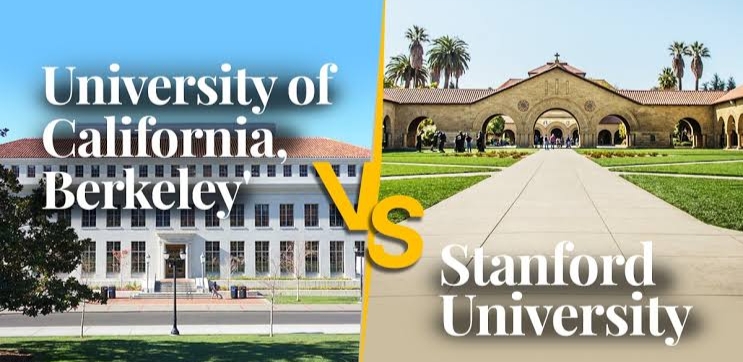
In California’s academic scene, two prestigious institutions, the University of California, Berkeley, and Stanford University, are widely recognized for their rigorous academics, pioneering research, and significant contributions to diverse fields. This comparative study examines the unique attributes that distinguish each university, including their histories, academic strengths, campus culture, and global influence.
History and Legacy –
The University of California, Berkeley, commonly referred to as Cal, possesses a significant historical background that can be traced back to its establishment in 1868. Serving as the primary institution within the University of California system, Berkeley has been influential in molding the academic environment of the state. Renowned for its dedication to public education and forward-thinking principles, Berkeley has served as a catalyst for societal movements and intellectual advancements.
Conversely, Stanford University, established in 1885, originated from the aspirations of Leland and Jane Stanford. Initially conceived as a tribute to their son, Stanford has evolved into a prestigious private research institution recognized for its enterprising ethos and pioneering advancements. Its association with Silicon Valley has bolstered its standing as a center for technology and commerce.
Academic Excellence –
Both Berkeley and Stanford are renowned internationally for their academic achievements, although they have distinct approaches. Berkeley, being a public institution, prioritizes accessibility and diversity. It offers a wide array of undergraduate and graduate programs, creating an environment that encourages students to participate in advanced research and engage with diverse viewpoints.
On the other hand, Stanford, a private institution, provides a more personalized academic environment with smaller class sizes and a focus on interdisciplinary cooperation. The university’s dedication to innovation is apparent through its close proximity to Silicon Valley, which facilitates strong partnerships with industry leaders and offers students exceptional opportunities for practical learning experiences.
Campus Culture –
The campus cultures of Berkeley and Stanford are distinct and reflective of their respective histories and values. Berkeley is renowned for its dynamic and politically engaged student body, with a longstanding tradition of student-led protests and movements that underscore a commitment to social justice and activism. The campus fosters a free-spirited atmosphere that encourages students to critically examine, challenge, and participate in open dialogue.
In contrast, Stanford’s campus culture is often characterized by an entrepreneurial and forward-thinking ethos. The university’s close proximity to Silicon Valley has cultivated an environment where innovation is not only encouraged but deeply embedded in the university’s identity. Students at Stanford are frequently immersed in a culture that prioritizes risk-taking, collaboration, and the pursuit of pioneering ideas.
Research and Innovation –
Both universities have made significant contributions to research and innovation, albeit through different approaches. Berkeley’s research strengths encompass a wide range of disciplines, with a particular emphasis on science, technology, engineering, and mathematics (STEM) fields. The Lawrence Berkeley National Laboratory, affiliated with the university, is widely recognized as a prominent hub for scientific research.
In contrast, Stanford, with its strong connections to the technology industry, serves as a hub for innovation and entrepreneurship. The university has played a pivotal role in the advancement of numerous technological developments, and its alumni frequently hold influential positions in leading companies in Silicon Valley. Stanford’s focus on interdisciplinary research has resulted in groundbreaking discoveries in fields such as artificial intelligence, biotechnology, and renewable energy.
More About –
In the competition between the University of California, Berkeley, and Stanford University, there is no definitive victor. Each institution has established a distinct presence in the academic realm, providing students with unique educational experiences and prospects. Berkeley is recognized for its commitment to public education, promoting diversity, activism, and intellectual inquiry. In contrast, Stanford is renowned for its emphasis on innovation, particularly in entrepreneurship, pioneering research, and collaboration with industry leaders.
Ultimately, the decision between Berkeley and Stanford hinges on individual preferences, academic aspirations, and the desired university experience. Whether one is attracted to the spirited activism at Berkeley or the entrepreneurial ethos at Stanford, both institutions continue to influence the future by producing graduates who make significant contributions to their respective fields and the global community.

 EduInsight